You Expect Me to Do What?!

“This is the kind of life you’ve been invited into, the kind of life Christ lived. He suffered everything that came his way so you would know that it could be done, and also know how to do it, step-by-step. He never did one thing wrong, Not once said anything amiss. They called him every name in the book and he said nothing back. He suffered in silence, content to let God set things right. He used his servant body to carry our sins to the Cross so we could be rid of sin, free to live the right way. His wounds became your healing.” (1 Peter 2:21-24, The Message)

The great Shepherd and Guardian of our souls set the example for those who follow him. I find it utterly distasteful!

Rather than doing what seemed right to him at the time, Jesus instead sought the will, direction and best purposes of God, in everything!

Rather than bending the facts of a matter to suit his comfort, his reputation, his purposes, Jesus instead spoke the truth without exception!

Rather than verbally striking back to defend his “rightness” and rather than calling down fire from heaven to redress wrongs done to him, Jesus chose instead to defer to God’s judgment and action in all things!

Rather than pitying sinful humanity for our inability to attain right standing with God, Jesus bore the pain of our punishment at the cross, so that the gift of salvation could be extended to everyone!

I am expected to follow this path? “Sheer lunacy,” I say! I much prefer pretending to obey the Ten Commandments, to give some of my money and to suffer the company of fools once a week on Sunday mornings. This whole call to the “normalcy of suffering” for the sake of reflecting the presence and power of Christ in me is bah humbug!

Or is it?!

Posted in Bible Study, Devotional | Tagged , , , , | 1 Comment

How Good is Your Shepherd?

“Once you were like sheep who wandered away. But now you have turned to your Shepherd, the Guardian of your souls.” (1 Peter 2:25, NLT)

One of the longstanding debates amongst the followers of Jesus is the efficacy of salvation, or “If a person is saved by grace can they subsequently lose that salvation?”

This passage is one of many which address this question. The answer is explicit in the text, since Jesus is the Shepherd and Guardian of my soul, I cannot overpower his work by act or attitude. Jesus said of himself that he is the “Good Shepherd who lays down his life for his sheep” and that “I know my sheep and my sheep know my voice” (John 10.11, John 10.27). The Bible gives witness that it was for the “love of the whole world” Jesus came (John 3.16) but only those who receive him shall be saved from judgment of sin (John 3.18). If we can somehow overcome that grace given to us, the name by which Jesus calls us, it would seem to quickly follow that Jesus is confused about his role since he doesn’t really know his sheep since the sheep he “now has” may not be his sheep at a later date.

Jesus wanted to make sure that his disciples knew how seriously he took the role of shepherd of souls. Toward the end of providing a peek into his heart, Jesus spoke the parable of the lost sheep (Matthew 18.12-14). Bottom line is that Jesus just is not into “losing” sheep and when “sheep” are lost, he goes and finds them.

It amazes me that so much valuable time has been expended on this singular question when Christians ought to be wrestling with the much more pertinent set of questions under the header, “How can I honor my shepherd?”

Peter, who knew a thing or two about being “lost”, admonishes the church with the answer. He tells the Christ-follower, “Since Jesus suffered on your behalf, you ought to also follow his example of suffering for his sake.” (1 Peter 2.21-23)

I know my shepherd will keep my soul until such a day as I am delivered into eternal rest; what I don’t know is whether or not I will honor the great price paid for my assurance with a life that reflects the enormity and value of the gift I have received. It seems to me that I have been given some measure of choice in the matter of whether or not to honor the one who gave up everything for me. It is my deepest hope that the sum of my life equals honor to the Shepherd and Guardian of my soul.

May it be so!

Posted in Bible Study, Devotional | Tagged , , , , | 3 Comments

To Disdain Repentance

“Therefore now, O Lord, please take my life from me, for it is better for me to die than to live.” And the Lord said, “Do you do well to be angry?” (Jonah 4:3-4, ESV)

 
What distress could cause a man to ask God to strike him dead?: The pain of watching the wicked turn from evil and violence and be passed over for judgment by God. It seems easy to judge Jonah’s unrighteous anger, but how often do we feel the same way. When we are wronged, it is not the case that we desire more that the perpetrator of the wrong be punished than we desire the offender to repent and be restored?

 We do not do well to be angry with God for withholding retribution in favor of grace and mercy. Such anger declares us unworthy of the same holy wrath being directed toward us. In other words, I am saying by my demand that God do something to punish the wicked that I am not in “that” group. Most of us do not want to be counted in the congregation of the wicked, but if we peel away the layers of our overly optimistic self-concept, we may find that we are not quite as pure as we may like to think.

 
We know this to be true of Jonah. Jonah possessed a task list given to him by God. Jonah refused to obey. As Jonah begged for mercy whilst he was in the belly of the great fish, he admitted to God that he had failed to keep the vows he made to the Lord (Jonah 2.9). Afterward, when Jonah was literally placed by God where he needed to be, Jonah did as little as possible to fulfill his commission and then hoped against hope that he would be unsuccessful. God didn’t destroy Jonah for his disobedience and recalcitrance, however, and allowed Jonah to instead to see his character, a God of great compassion even toward those who are wicked (Jonah 4.2, 10).

It is a fact in evidence that Jonah was not nearly as wicked as those God chose to save. I may not be as wicked as someone I want God to “take care of” because they have caused me pain or other harm. It is true of both Jonah and of me that we need God’s compassion worked through mercy and grace: the withholding of judgment and the offer of unmerited gifts.

 The Bible comforts us to with the promise that God will righteously judge (Psalm 7) at just the right time and that those who plant wickedness will receive a harvest of the same (Galatians 6.7). For my part I am glad that God tempers these promises with the same compassion he extended to incredibly wicked Nineveh so long ago.

Marvelous grace of our loving Lord, grace that exceeds our sin and guilt! Yonder on Calvary’s mount outpoured—there where the blood of the Lamb was spilt…Grace, grace, God’s grace, grace that will pardon and cleanse within; grace, grace, God’s grace, grace that is greater than all our sin!—Julia H. Johnston “Grace Greater Than Our Sin”

Posted in Bible Study, Devotional, God Questions | Tagged , , , , , | Leave a comment

“For the Sake of the Children”

And I said, “O Lord God of heaven, the great and awesome God who keeps covenant and steadfast love with those who love him and keep his commandments, let your ear be attentive and your eyes open, to hear the prayer of your servant that I now pray before you day and night for the people of Israel your servants, confessing the sins of the people of Israel, which we have sinned against you. Even I and my father’s house have sinned.” (Nehemiah 1:5-6, ESV)


Nehemiah’s prayer, offered over several days, was not only the recognition that his current generation was living apart from the will and direction of God, but also a confession that his ancestors had done the same. Nehemiah’s reality of captivity in a foreign nation was not the direct result of his actions or the actions of his fellow Israelites, but the consequence of the actions of those who lived long before he was born.


In our culture we are constantly bombarded with dire warnings about the effects of our corporate actions on our progeny. “Reduce carbon emissions, stop growing the national debt and our personal debt, reduce the amount to sugar intake and lower your body mass index, use less healthcare, don’t cut old growth forests…” From my perspective I see these pervasive and persistent cries for repentance for “the sake of the children” largely ignored. We pretend to care, but we are really much more interested in our own common comforts. Though most don’t desire our children to suffer and do really want them to have a “better” life than we experience, we are unwilling to make the necessary sacrifices to make a real difference.


This is most evident, I think, in our spiritual lives. We may make some minor adjustments to our lifestyle to “slow global warming” but the major changes demanded by the presence and power of the Holy Spirit are too foreign to our pampered existence to be acted upon. Since we are largely unwilling to “leave all and follow Jesus” we are neither model spiritual maturity to our children nor challenge them to lives of desperate obedience to Christ. The outcome of parental apathy and disobedience regarding the commands of Christ is a heritage that will, in the end, invite the same kind of reality as Nehemiah experienced: desolation of our spiritual home and contemporaries who are largely disinterested in doing anything to repair the lost relationship with God.


The wonderful part of God’s character is that he is not overcome by our generational drift and he is willing and able to restore to himself all those who call upon his name. We would do well to ponder the fact that the God of Christianity has been declared dead again and again over the last one hundred fifty years and yet still seems to be able to engage people in every culture and place in a real and life-changing manner. For my part, my grandparents were not driven by obedience to Jesus, yet God interdicted the life of my parents and gave them a passion to follow him, no matter what the cost. This is my heritage, one that I am determined to do all I can to pass along to my children. To each generation is given the choice to receive or reject the Lordship of Jesus, it is my prayer that those presently alive in Jesus would be about the business of doing all they can to make sure that Nehemiah’s prayer does not need to be repeated.


Make it so Lord.

Posted in Bible Study, Devotional | Tagged , , , , | 1 Comment

Pictorial Narrative of the Uganda Experience (pt. 4)

Because the work we participated in focuses on sharing the gospel with the very poor, the issue of a meeting place is paramount.  The local Ugandan congregation is not able to financially support their pastors (pastors keep jobs and minister to their congregations…that is why the majority are still single!) and paying rent for meeting places normally consumes the entire wealth of the congregation. Hopeful LandSome of our friends here in the United States have been burdened by this situation and are giving funds for the procurement of land for these congregations.  This plot was recently purchased for the sum of $8,000 USD, which is a small fortune in Uganda.  The congregation is currently paying week by week for the excavation of a pit latrine which must be completed before the local town council will allow for construction to commence.  After the latrine is ready, the congregation must have enough funds and labor available to put the entire structure up within a day.  Because this plot is in the center of a Muslim neighborhood, any partial structure will be torn down and the materials “disappeared” by the Muslims in order to prevent a Christian influence in their neighborhood.


50 ft. straight down...called a "long drop" latrine.

50 ft. straight down...called a "long drop" latrine.

It is my understanding that the Muslim world sees Uganda as a “gateway” country to Southeast Africa.  If Uganda can be pressed or persuaded into being a Muslim state, then the thinking is that there will be a power base established for the subsequent “conversion” of the neighboring countries.  Prominent Muslims like Muammar Khadaffi, of Libya, have poured money into Uganda in order to support the advance of the Muslim religion.  It seems to me that the purchase of religious adherents is far better than conversion by military or political force, but it was heartbreaking to talk with people who were Muslim only because someone said to them, “I will feed you if you convert,” or “I will give you a business if you convert.”  Nearly all those I spoke to had little idea of even the basic ideology of the Prophet to whom they have sworn allegience.  They were fearful of incurring either the wrath of Allah or the wrath of their benefactors (or both) even by speaking with an American Christian.  Several such individuals who were made Muslim without their consent (by threat of loss of family connection and/or ability to make a living if they did not become or remain Muslim) came under cover of dark to watch the Jesus Film. We showed the film in Banda (Kasokoso) and in one of the marketplaces in Namuwongo, near Soweto.

For a few shillings just about anyone can rent space...even in the middle of a marketplace.

For a few shillings just about anyone can rent space...even in the middle of a marketplace.

Just the mere setup of a film screen began to attract a crowd.  The merchants were not happy as they thought that free entertainment would somehow stunt their normal business.  From an American point of view it would be an opportunity to attract nearly 1,000 people to a marketplace, but perhaps the local merchants were right and we cost them business.  The prospect of lessening the ability of some to provide for their families bothered me quite a bit, but making things “right” with the merchants was not a possibility.  If I were to participate in this kind of thing again, I would make allowances for reimbursing the merchants for lost sales ahead of time so that the aroma of Christ remained as a sweet memory and not a bitter stench.  Some things are best left to the work of the Holy Spirit, however, and I trust that God made good even of our misstep.

A small sampling of the crowd gathered for the Jesus film.

A small sampling of the crowd gathered for the Jesus film.

One of the greatest privileges of the whole trip was the training session we conducted with the church leaders.  We presented the pastors who had completed basic training with NIV Study Bibles with their names imprinted on the cover.  The were so overwhelmed that we were embarrassed.  Two of the Pastors stood and gave testimony that our bringing of these Bibles was a direct and specific answer to prayer.

Praying over the meeting with the Kampala Urban Team church leaders.

Praying over the meeting with the Kampala Urban Team church leaders.

The Bibles are available in Uganda but cost about 120,000 shillings–which is simply too much. 

We taught the leaders about using the simple things in their lives to draw out spiritual lessons.  We believe that too often churches are so focused on the esoteric that we forget that God always met people in the midst of their life.  Even the spiritually central exodus from Egypt is marked by God’s presiding over the mundane needs of his people by providing food and water. 
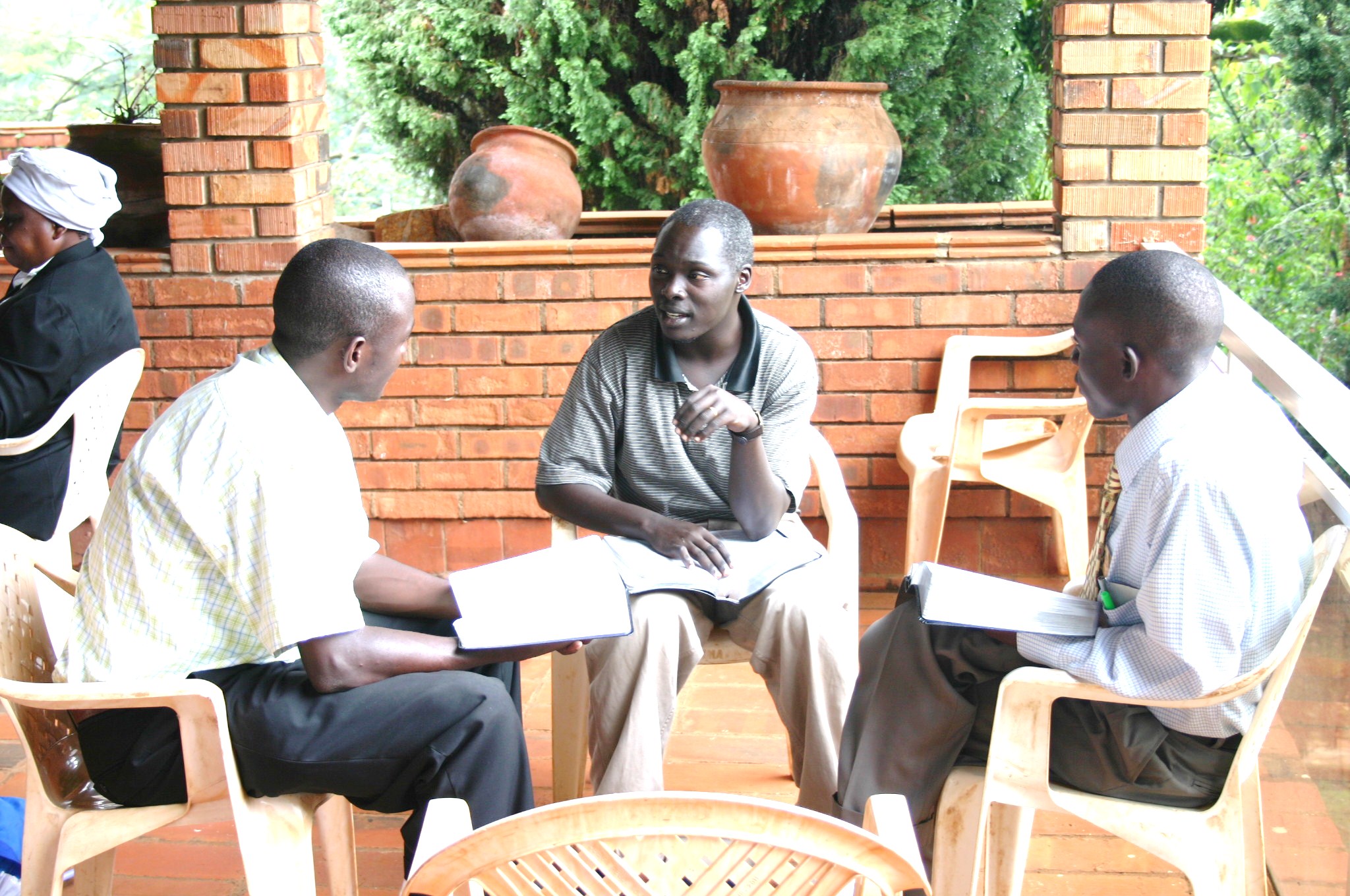
Three of the top KUT pastors exchanging ideas.

Three of the top KUT pastors exchanging ideas.

Most of the pastors caught on right away and they were excited to put their new Bibles to work.  We split into small groups and had the pastors practice the driving principle of the afternoon’s session “information with application is just air.”  On a side note, early this afternoon it rained…I mean really rained.  It seemed as if all of Kampala came screeching to a halt.  For the Ugandans, rain is something akin to our snow storms.  They don’t like to go out into the rain, they won’t work in the rain, they absolutely will not travel in the rain.  Our meeting got started about an hour late so that those who were avoiding the “bad weather” could finally arrive.   We thought it kind of funny…after all it was just rain, but I am positive people from Iceland think it ridiculous when we cancel school over a dusting of what we call in the Cinci area, “white death.”

There is so much more to share, but one picture more will have to suffice for now.  This picture is a great example of the difference between our culture and the culture of our brothers and sisters in Uganda.  We never think about some of the things we take for granted (like toliets) and it is beyond our comprehension to consider doing common tasks by hand.  Even the guest house where we stayed did laundry in the fashion depicted below.  We who are well-fed, pampered, and are freed to pursue the pleasures and interests of life would do well to remember that ours is the minority experience.  Most of the world understands this picture far more than we.

Maytag has nothing on this lady...one good reason to have few clothes!

Maytag has nothing on this lady...one good reason to have few clothes!

Posted in Current Events, International Travel | Tagged , , , | 3 Comments

Who art Thou?

But seek first the kingdom of God and his righteousness, and all these things will be added to you. (Matthew 6:33, ESV)

In 1991 I found myself unemployed for the first time since age 14. I had in my hand seven years experience (and success) in the working world, a college degree magna cum laude, and both the pressure and passion to provide for my young wife and two toddlers.
I had left my secure and lucrative UPS job to pursue my graduate education at Oregon State University, but right before we were to move from Southern California my degree program was gutted by state-wide budget cuts. I now had no job and no clear direction, but we had a place to live (thanks to my wife’s parents) and savings in the bank. After about three weeks I discovered that the world was not going to knock at my door and offer to give me work to do, so I started pounding the bricks looking for work…nothing. I ended up working three “jobs” to keep afloat as I watched our savings account disappear and then our credit card (for the very first time) begin to show a monthly balance. My father brought us food from his pantry to help us survive.

No more going out to eat, no purchasing of new clothes, no driving places we didn’t have to go to, no movies on the weekend. One month I had to make a choice between paying for rent and food or keeping full coverage insurance on our new (and completely paid for) car. I chose to pay rent and to feed the family. Michelle was involved in a horrific wreck about a month later and we were forced to sell the remains of our vehicle as junk. I finally got a job working for a grocery store at an hourly rate of about one-third of what I earned at UPS. The store did not give me full time hours, so I painted apartments and did handyman work on the “off days” to try to keep us from falling further behind. This was to be the beginning of a very, very, very, difficult year.

I wrote the following in my quiet-time journal:

As I am looking for a new line of work and am in that “in-between” place trying to find self-identity and purpose, I have been hit square in the forehead with a shocking and revealing look at myself. The occasion for this Spirit-led insight was two paragraphs in Douglas Webster’s Christian Living in a Pagan Culture.* Webster states, “Probably no other period in history has known such an intense preoccupation with the question, ‘Who Am I?’…The new mentality [of the Christian] has a different starting point. The crucial question is not ‘Who am I’ but ‘Who art Thou?’ 

I was immediately reminded of the “seek ye first…” passage in Matthew and subsequently convicted that seeking God was the last thing I have been doing the midst of this ordeal (unemployment). My whole life focus for going on three years has been, “Who Am I?”. 

How much have I missed? What blessings have I robbed myself of because of my preoccupation with self? I pray that it is not too late to reverse the introversion and to once again seek wholeheartedly my God and let Him “add all these things” unto me.

Looking back I can say that God honored my attempt at reversing course and “added all things” in a measure I could and will never merit. How great it is to have the care of a powerful and loving God who, even in the midst of devastating circumstances, calls us to put him first—because He is worth first place.
*Webster, Douglas D. Christian Living in a Pagan Culture. (Tyndale House Publishers, ©1980). ISBN 978-0842302418, out of print.

Posted in Bible Study, Devotional | Tagged , , , | Leave a comment