
My mother and father took their vows to an altar they were convinced was unassailable. I soon arrived followed by a brother, another brother, and finally a sister. If a family were nuclear then we were explosive.
Both sets of grandparents remained married until death parted them. I attained more than twenty years before the first of them left this world.
Aunts and uncles aplenty and enough cousins to make a rabbit hutch envious rounded out what could be considered ‘family extended.’
We were connected but not close, obligated but not obliging, affected but not affectionate.
And then Jesus showed up and elevated the complicated conflicts of our family relations to unimaginable heights.
“Do you suppose that I came to grant peace on earth? I tell you, no, but rather division; for from now on five members in one household will be divided, three against two and two against three. They will be divided, father against son and son against father, mother against daughter and daughter against mother, mother-in-law against daughter-in-law and daughter-in-law against mother-in-law.”
(Luke 12:51–53, NASB95)
The ‘intact’ family was officially shattered when my mom and dad responded to the call to become followers of Jesus Christ. Truth be told, our extended family shared blood, but most often the relational dynamic was more about shedding blood (metaphorically anyway) . While the family God wove together was and is never abandoned, new threads appeared in the tapestry of kin. Rejected as ‘freaks’ by most of our family we were received by total strangers through obedient and willful adoption.
The divergent grafted us into their corporate and familial life. Fellow worshipers of Jesus now stood up as aunts and uncles and cousins. No shared blood among us, but rather a shared Spirit of pure, holy, love. While this family was never a perfect communion, they encouraged us, served us, blessed us, gifted us without expectation of return.
This is what a knew all my life. I honestly thought I had ‘family’ pretty well figured out.
When Paul wrote,
He predestined us to be adopted through Jesus Christ for Himself, according to His favor and will…(Ephesians 1:5, HCSB)
I got it. I knew being part of God’s family was His choice and not mine; His grace and not my work. Family was about being included in God’s work of redeeming humans from their irreparably broken state. Yet my understanding proved exquisitely immature.
When the choice was made to receive Isaac, Penny, and Lionel into ‘my family,’ it seemed both natural and true even though our color, nationality, and life-experience was as disparate as north and south, east and west. To be ‘dad’ to these three was a reflection of Love flowing through me not from me. My wife would have three more children, my children three new siblings, my parents three more grandchildren. It would all be good, but it was not.
Trouble arrived on a tangent I would not have predicted. I quietly wrestled with my own heart, sharing my pain with no one. I couldn’t understand why I couldn’t achieve a better perspective no matter how many times I manipulated my own position in relation to the problem vexing me.
Two years ago I stood up with Peninnah at her wedding, taking up the role of her deceased father. I burst with joy and I felt deeply humbled to be included in the ceremony. I took advantage of the proximity to both Isaac and Lionel (on separate occasions) to breach the topic causing me so much concealed consternation: Why were they calling so many other people ‘dad’ and ‘mum’? Didn’t they understand parentage was a mutually exclusive relationship? Was the effort and sacrifice my wife, Michelle, and I were making somehow not enough?
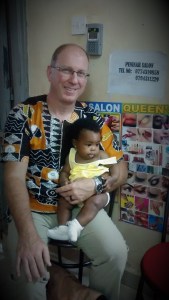
Sitting in Penny’s hair salon with the lovely (and magnificently healthy) Mayers.
For Ugandans titles of parentage are not exclusive to biological paternity and maternity. Children do not bear a family surname. Isaac, Penny and Lionel have different ‘second names’ but are still biologically related. I knew this, and that fact alone should have provided me a hint for understanding, but it did not. Biological parentage is revered and bears responsibility and privileges familiar to most of the rest of the world, but in Uganda an aunt or uncle or respected elder friend can, and often is, called ‘dad’ or ‘mom’. For Ugandans, what someone is ‘called’ is based upon relationship rather than just ‘relations’.
I embarrassingly confess this took far too long for me to process. It hasn’t been that long since I finally settled on what was tripping me up. It was two prideful letters, ‘m’ and ‘y’. Even though I have benefited from decades of being part of what is exclusively ‘His’ family, the temptation of the ‘my’ still crept into my heart and took residence. I was deeply grateful for the many ‘moms’ and ‘dads’ who poured into the ‘Uganda Three,’ but I didn’t want my position to be diminished.
Ryan, Alyssa, Emily, Isaac, Penny, and Lionel are my children no doubt about it, but they do not belong to me. I have no exclusive right to any of them. For instance, Ryan is Maggie’s, Alyssa is John’s, Emily is Mark’s, Penny is David’s, given to each other by covenant of marriage. Each of them now has new relatives to whom they are not related. I was an integral part in each of the ceremonies.
Duh!
And so I move along, prayerfully wiser (and more humble) because of the journey. Family does not belong to me and is not defined by me. I am a man blessed with an amazing father, rescued by the adoptive Father, enriched by fathers who poured life into me, drawing deeply from the wells of their lives. God, by His design, made us capable of connecting to each other beyond the confines of the boxes we often unconsciously build to keep people out. He gave us blood-family and He gave us grafted-family in order to make us wealthy with love.
I will happily give up the ‘my’ so that it may be so!


 TheNarrowRoadPursued