
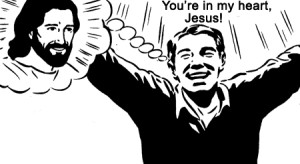
 I have been crucified with Christ; and it is no longer I who live, but Christ lives in me. http://goo.gl/OQ541L Power I need everyday.
This simple phrase speaks perhaps the most overlooked truth of the Christian life.
Modern Western Christianity loves to talk about ‘having Jesus in my heart,’ and the ‘inner power of the Spirit,’ and some who consider themselves Christian verbally invoke the Spirit in order to do the bidding of their own desires.
Rarely, however, is there conversation about the Spirit of Jesus ruling a person’s heart toward the end of complete Jesus-like obedience. I am certain that in my own life such a dialogue would be warmly welcomed but also immediately met with the resistance of a heart thoroughly convicted.
Jesus is so much better for me if he is a standard to admire, or a bar to try to jump over, or even the Masterful Savior who is seated at the right hand of the Father. All these things keep the true power of Jesus’ claim on me just far enough away for me to ignore him whenever I wish.
If Christ truly lives in me, then I have no excuse to refuse God’s authority. Jesus, even as he considered the horrific cost of his life, did not every say, ‘no.’
“The faith for which the apostles called involved not simply belief in the factual truth of the story of Jesus as they proclaimed it, but an unconditional self-commitment to the Jesus of whom the story told. This meant that they relied upon Him there and then for the remission of sins that was offered in His name. But it meant more: it meant that they relied upon Him henceforth for victory over the power of sin. It meant that they were now Jesus’ men and women, set apart to be like Him and to carry on His work in the world through the energy supplied by His Spirit within them. There is, to be sure, an initial act of faith in the sincere response to the gospel, but that act of faith, if it is genuine, is but the beginning of a continuous life of faith—a life in which the believer “holds to Christ, and for the rest is totally uncommitted.”–F.F. Bruce
Excerpt from a first century, unsigned letter to Roman official Diognetus explaining how to identify a Christian:They live in their own countries and are strangers. They loyally fulfil their duties as citizens, but are treated as foreigners. Every foreign land is for them a fatherland and every fatherland, foreign.
They marry like everyone, they have children, but they do not abandon their new-born. They have the table in common, but not the bed. They are in the flesh, but do not live according to the flesh. They dwell on earth, but are citizens of heaven.
They obey the laws of the state, but in their lives they go beyond the law. They love everyone, yet are persecuted by everyone. No one really knows them, but all condemn them. They are killed, but go on living. They are poor, but enrich many. They have nothing, but abound in everything. but in that contempt they find glory before God. Their honor is insulted, while their justice is acknowledged. [Water, M. (2001). The New Encyclopedia of Christian Martyrs (p. 69). Alresford, Hampshire: John Hunt Publishers Ltd.]


Galatians 2:20,21 are my life verse…oh but that I might be identified as a Christian by the letter quoted above. (letter to Diognetus) So much to ponder in your daily devotionals Robert. Thank you.
3-21-15
Greetings, Robert. Thank you for yet another excellent devotional. May I use your quote from Diognetus? I’m working on a devotional re: “The Wilderness” and may include it. It’s good to be in touch with you via your writings….reminds me of our “writers’ table” with Steve Holloway at Highland Heights Perkins….lo, many years ago! 🙂 Agape! – Bruce Peters
You may use anything you find helpful…no need to ask.