
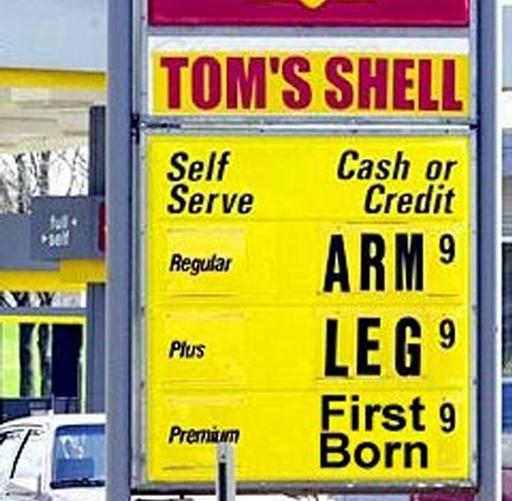
 If you went to the gas station expecting to pay well over $4.00 for a gallon of gasoline and watched the pump tally your purchase at the rate of $1.10 what would you do? Would you go in and offer to pay the difference? Would you text all your friends and inform them of the windfall? Would you honor the request of the station owner and help offset his $21,000 one-afternoon loss by paying your fair share?
These and more “moral responsibility” questions are being considered today after the situation described happened in Wilmington, CA. I know enough about the news cycle to be certain that this whole story will be forgot by tomorrow or perhaps even this evening. The story does stir my heart, however, perhaps not for the reasons the reader may expect.
Yes, the gas station owner’s catastrophic loss at the willing hands of his customers is sad, but no more so than the loss of hundreds of farmers along the Mississippi valley spillway are experiencing right now. What is troubling is the underlying values to which our adrift culture currently clings.
Since we have told God to “go away” and leave us alone unless we need someone to curse, we Americans have fully adopted the idea “more for me” is nearly always a good thing. Even the famous mantra, “Well, it didn’t hurt anybody,” is now abandoned for the, “It didn’t hurt anybody I care about.”
Even within the Christian church the confession, “He must increase, but I must decrease,” is regulated to the silly notions of ancient religious fanatics. We worship together at the base of the engraved image of the system that promises to us so long as we get more for us there will always be more to get and those with less will eventually benefit by our consumption. To suggest that an American should live less comfortably for the sake of another person’s survival (or minimal comfort) is akin to high treason, or better yet, terrorism.
A friend gave me one of the best gifts I have received in a long while, a series of one-on-one interviews with a fascinating people speaking to the content of their published work in a variety of fields (see the Mars Hill Audio Journal). I found the interview with John C. Medaille particularly compelling. His work on the economic theory of distributivism is worth consideration by modern Christianity.
It is my belief that unless the Church begins to take Jesus’ instruction on the mount more seriously we are dooming ourselves to consciously take advantage of each other more and more often. $1.10 gasoline will be the least of our worries.
“And if anyone would sue you and take your tunic, let him have your cloak as well. And if anyone forces you to go one mile, go with him two miles. Give to the one who begs from you, and do not refuse the one who would borrow from you. “You have heard that it was said, ‘You shall love your neighbor and hate your enemy.’ But I say to you, Love your enemies and pray for those who persecute you, so that you may be sons of your Father who is in heaven. For he makes his sun rise on the evil and on the good, and sends rain on the just and on the unjust. For if you love those who love you, what reward do you have? Do not even the tax collectors do the same? ” (Matthew 5:40–46, ESV)


Just when I got my head wrapped around Austrian economic theory ( http://mises.org/ ) and Freegold ( http://fofoa.blogspot.com/ ), now I’ve got Distributivism to figure out!
Well now I get to read about Austrian economic theory and Freegold…so we are even!
I think the Wikipedia article on Distributism is worth linking as well: http://en.wikipedia.org/wiki/Distributism
Chesterton was a great man, so I guess I have one more thing to admire him for. And I suppose I’ve been a Distributivist for a while now, and just didn’t know it!
Here is a thought I had reading through all this: An owner of a productive piece of property must by necessity be a Saver — frugal, thrifty, willing to live below one’s means in order to produce a surplus to provide through the lean times. We live however in an era of Debtors — those who would rather borrow to pay for today and put off repayment to some other time. In a Distributivist world with a smaller government and credit unions instead of banks (at least as we think of them today), there will not be enough lending/entitlement funding to service very many Debtors.
It seems, then, that any such Distributivist world is at least a generation away, if not more. And the transition to such a world, while perhaps not particularly bloody, will be painful indeed. Perhaps it will take Christ’s physical return to earth before such a thing can occur?
Just a few thoughts.
Thanks for the extra link! After reading the links you provided last comment, I thought you would feel a sense of familiarity. My interest in distributivism is primarily related to what we term “emerging economies.” Can we get to them before they become addicted to consumerism?
I’d be interested in discussing this with you at greater length. Who is “we”? Who is “them”? And how do we get to them? I’d love to hear your thoughts — they have application right here in our own “submerging economy” as well.
I used the impersonal plural pronoun “we” to refer first to all Americans and then to the group within America referring to themselves as “Christian.” I didn’t really refer to the “them” directly. I think the “others” will be different for different sets of people. I have a different perspective than many in our culture. I grew up in a family where my parents worked hard to make a life for themselves, but were only able to climb from the under class to the middle class economically. We lived in a neighborhood that was predominately under class. I saw people work for beer/drugs and rent (in that order). I also saw my parents share unreservedly with those who had less than we did. The “others” were people next door or across town. I also have been to Africa and seen the hopelessness that corruption and lack and disease wreaks on a country. For me the “others” include those without who are near and those who are far. My challenge is to decide where my limited resources can best be used. The world is full of need and even if there were a complete and massive redistribution, one day later need would arise. I recognize this fact. I know that the only thing I can do is share Jesus’ love first, take care of my “neighbor” the best I am able second, and trust God to do what only he can do. I would love to discuss this further with you. Most people’s eyes glaze over whenever I bring the subject up.
In a world where 6% of the global population uses well over 25% of the global resources and where the other 94% are starting to catch on that this is maybe not such a good arrangement — and where historically many wars are fought over scarce resources — I can think of no other topic with quite the same degree of practical importance.
On a slightly different note, I think my tendency is to reverse the order of priority that you mention — “you can’t preach Christ to starving people”. So I tend to think in terms of meeting material needs first, and using the meeting of those needs as a vehicle to share Jesus’ love. Personally, this is an ongoing area of growth — kind of a chicken-and-egg issue that I continue to wrestle with.
I’ll look forward to our next chance to discuss this.